





Digital twins in the maritime world
Key insights
- Digital twins transform the sea into a data space where each ship, each port, now has its virtual reflection
- Their use reshapes the contours of navigation, maintenance, and decarbonization, making the virtual a strategic partner of the real
- By linking data, artificial intelligence, and simulation, they offer unprecedented predictive control, capable of anticipating failures or optimizing maritime routes
- But their power relies on a fragile substance: the reliability of the information that feeds them and the robustness of the models that animate them
- Behind the digital mirror, human and ethical questions remain: who governs these digital doubles, who guarantees their security, and how far can we delegate decision-making to the machine?
A digital twin is a virtual representation of a real object, system, or process. It is created using real-time or historical data, mathematical models, and algorithms to simulate the behavior and characteristics of the real object.
The digital twin can be used in various fields such as manufacturing, engineering, healthcare, transportation, etc. It allows monitoring, predicting, and optimizing the performance of the real object by providing accurate and real-time information about its state, operation, and environment.
Digital twins offer three major advantages: cost reduction, improved safety, and reproducibility. They can be used to predict scenarios, but also serve to train people safely.
In the maritime field, digital twins have multiple use cases that we will discuss throughout this article.
Digital twins can be used to monitor and manage different aspects of ships, ports, and maritime operations.
Here are some examples of digital twins that evolve over time and reflect the changing state of their physical counterparts in the maritime industry:
Monitoring ship performance : Digital twins of ships collect real-time data on parameters such as speed, fuel consumption, engine performance, and environmental conditions. By comparing the performance data of the digital twin with the physical ship, operators can optimize energy efficiency, predict maintenance needs, and ensure compliance with environmental regulations.
We present this practical example:
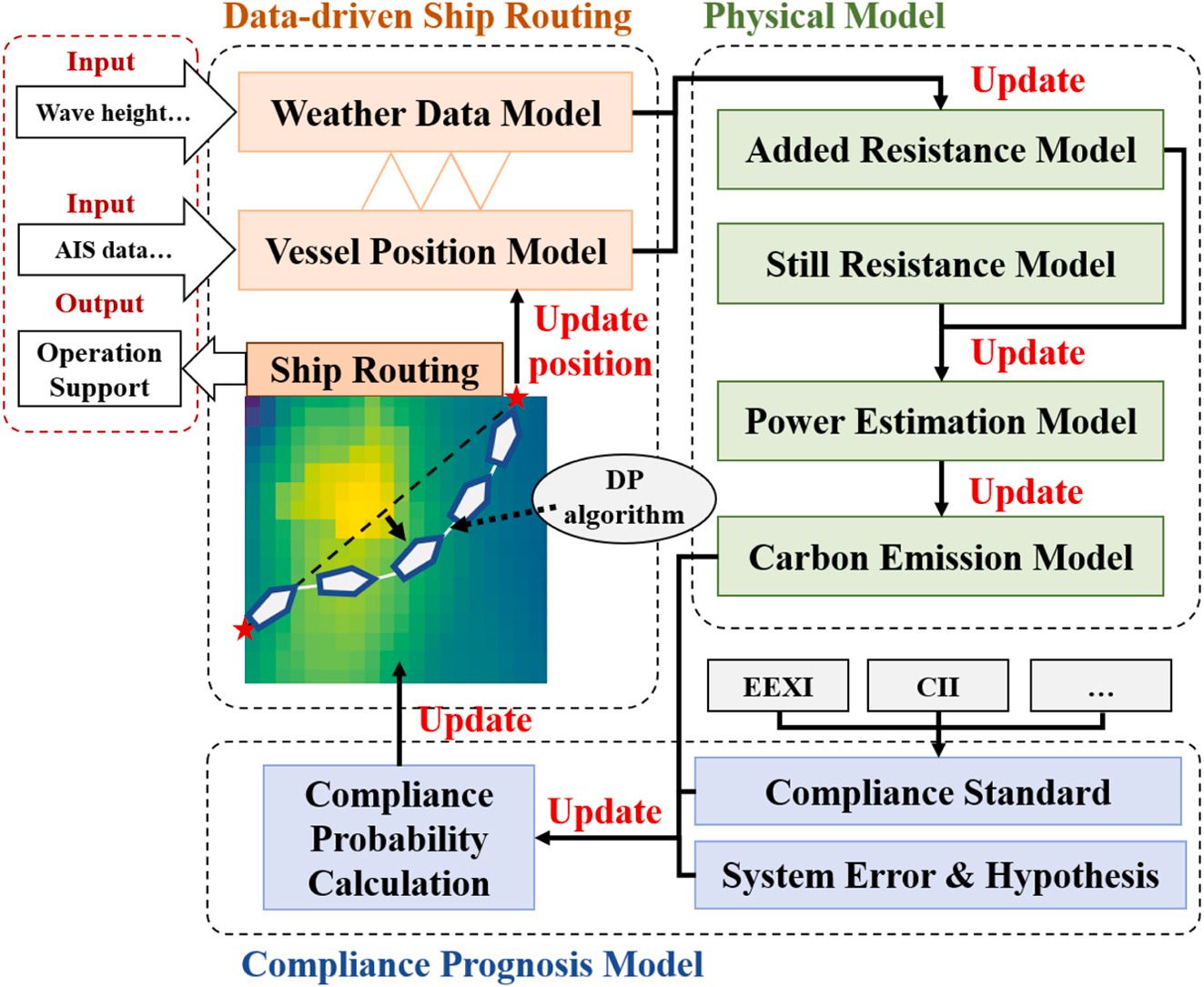
A case of digital twin for real-time routing of ships taking into account regulatory compliance regarding decarbonization.
In this example, digital twin technology is used to facilitate real-time assessment of regulatory compliance regarding decarbonization in ship routing.
This approach focuses on real-time monitoring of the carbon emission intensity of ships and identifying potential strategies to mitigate operational risks related to decarbonization goals. By leveraging up-to-date environmental and operational data, the digital twin approach enhances the accuracy of estimating the likelihood that a specific ship will comply with regulations throughout its journey. This example offers a proactive and data-driven approach to support the maritime industry's decarbonization efforts.
Management of port operations:From the data of the digital twin, we can monitor port operations, including ship traffic, container movements, and berth utilization. As the port experiences changes in ship arrivals, cargo volumes, or infrastructure improvements, the digital twin adapts to reflect the changing conditions. This allows for real-time resource optimization, efficient berth allocation, and improved logistical planning within the port.
Here is a practical example:
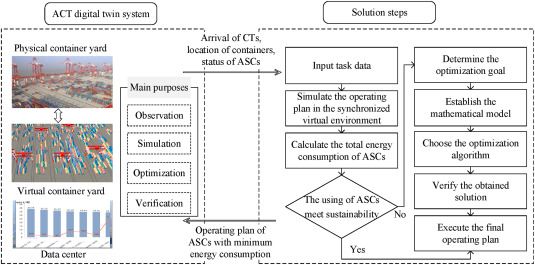
A digital twin-based approach to optimize energy consumption during automated container handling operations.
This approach proposes using digital twin technology to optimize the energy consumption of an automated stacking crane (ASC) involved in container handling operations. The approach involves developing a virtual area of containers that synchronizes with the physical area of containers in the digital twin system in an automated container terminal, for observation and validation purposes. A mathematical model is then established to minimize the overall energy consumption required to accomplish all tasks.
Digital twins based on artificial intelligence techniques.
Building a digital twin using artificial intelligence (AI) techniques may be more appropriate in the following scenarios:
High complexity: AI can be beneficial when dealing with very complex systems that involve many interactions and interdependencies. By using AI, it becomes possible to model and simulate these complex interactions more accurately.
Heterogeneous data: When data from diverse sources with varying formats, structures, and resolutions are needed to build the digital twin, AI can effectively process and integrate this heterogeneous data, referred to as multimodal models.
Dynamic adaptation: If the real system requires real-time adaptation based on changing environmental or operational conditions, AI enables the digital twin to make decisions autonomously and adjust its parameters accordingly.
We propose this practical example:
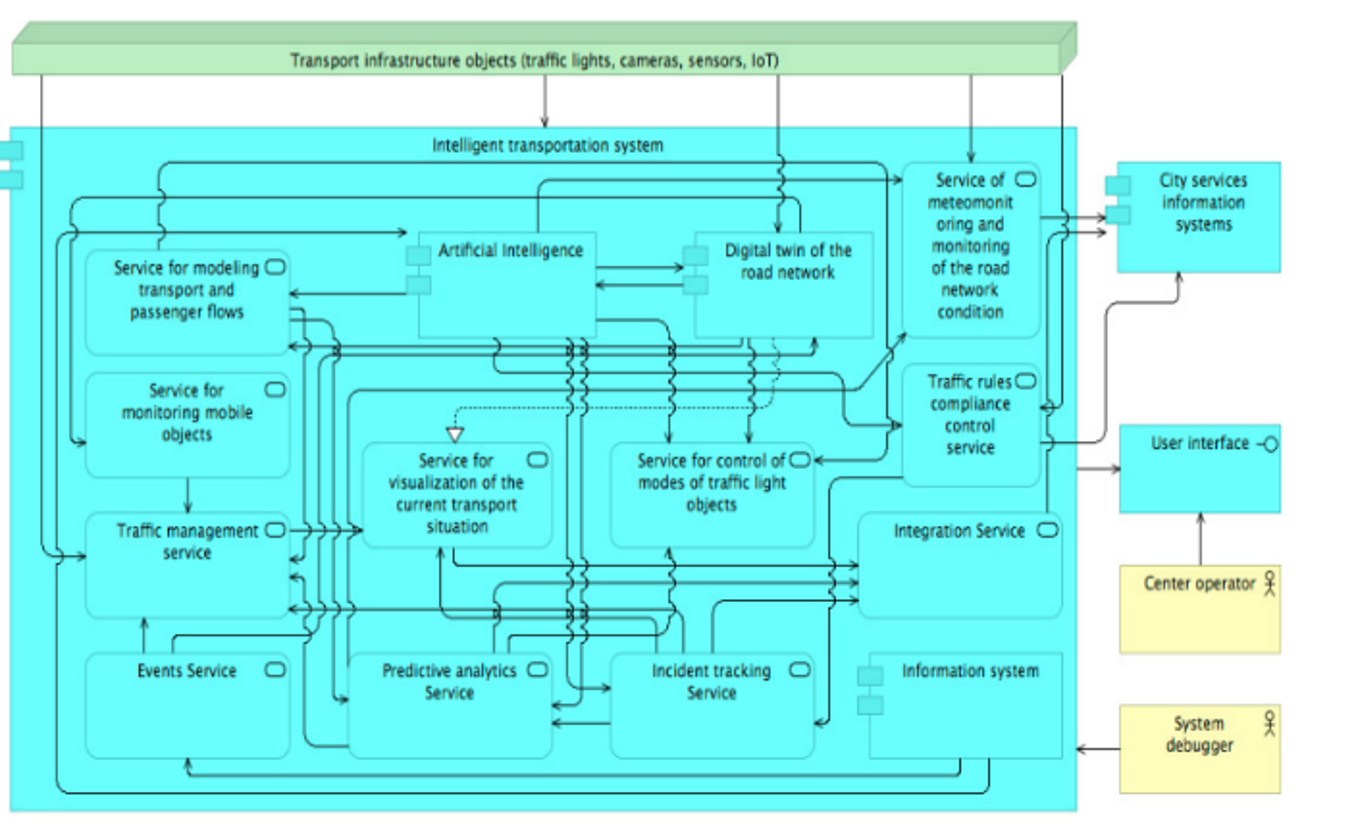
Digital twins in intelligent transportation systems
Traffic management in urban areas and high-traffic maritime zones remains a major concern. Traditionally, control centers have been used to address these challenges, but they now require modernization through the incorporation of digital twins and artificial intelligence (AI). The implementation of intelligent transportation systems (ITS) offers a solution to the main problems encountered in transportation networks while facilitating their development. By using digital twins with the ArchiMate modeling framework, we can optimize the distribution of traffic flows in the network over time and space.
The Limitations of Digital Twins…
Digital twins have gained attention and popularity across various industries, offering the potential to enhance design, simulation, and analysis capabilities. These virtual replicas of physical assets enable real-time monitoring, predictive maintenance, and performance optimization.
However, like any technological advancement, digital twins also have their limits, both in theory and in practice.
In this section, we will explore the disadvantages and potential challenges associated with digital twins, highlighting specific examples where these limits have been observed in real-world scenarios. By understanding these limits, we can gain a comprehensive perspective on the benefits and considerations of using digital twins in the maritime world.
Data accuracy and reliability: The effectiveness of digital twins heavily depends on the accuracy and reliability of the data used to create and update them. Incomplete, outdated, or inaccurate data can lead to discrepancies between the digital twin and the real system, impacting the reliability of predictions and analyses.
Model complexity and assumptions: Developing an accurate digital twin often requires simplifications and assumptions about the real system. However, these assumptions do not always hold true in practice, leading to disparities between the digital twin's forecasts and the actual behavior of the system.
Computational requirements: Implementing and maintaining a digital twin may require significant computational resources, especially for complex systems or advanced simulation techniques. This requirement could limit scalability and accessibility, particularly in environments where resources are constrained. Additionally, ship connectivity at sea requires a satellite system to ensure good data frequency.
The three aforementioned limitations can be illustrated by the example below:
“The use of incomplete or misused data can have serious consequences. A concrete example of this situation occurred during the crash of two Boeing 737 MAX airplanes. It appears that digital twins were used during the construction process to make modifications to these planes. However, it is possible that a divergence between the data used in simulations and the real data contributed to these accidents.”
Integration challenges: Integrating data from diverse sources and systems to create a complete digital twin can present difficulties. The diversity of data formats, standards, and protocols between systems requires complex and tedious data integration processes.
Cost and time considerations: Creating and maintaining a digital twin incurs significant costs, including data acquisition, sensor deployment, software development, and ongoing maintenance. Furthermore, collecting, processing, modeling, and validating data is time-consuming.
Privacy and security concerns: The real-time data capture and analysis involved in digital twins raise privacy and security issues. Protecting sensitive data, ensuring privacy, and safeguarding against cybercrime are all factors that must be considered in the design of digital twins.
Human factors and expertise: Although digital twins provide valuable insights, human interpretation and expertise are essential for drawing meaningful conclusions and making informed decisions. The human element is crucial for understanding context, interpreting results, and applying domain knowledge to fully leverage the potential of digital twins.
It is important to note that specific limitations may vary depending on the application and implementation of digital twins. Difficulties may arise when integrating data from disparate sources, managing existing systems lacking standardized interfaces, or handling large volumes of real-time data.
Furthermore, issues related to data quality, sensor reliability, and the need for continuous calibration and maintenance can impact the accuracy and effectiveness of digital twins in practice.
Digital twins can enable operators to monitor and control ships remotely, optimize performance, predict failures, and make informed decisions in real time. Automation based on digital twins also offers the possibility of reducing reliance on human labor, increasing operational efficiency, and minimizing the risk of error. Smart ships thus represent a new era in the maritime industry, opening the door to smarter, safer, and more sustainable operations.
References
Diego M. Botín-Sanabria, Adriana-Simona Mihaita, Rodrigo E. Peimbert-García, Mauricio A. Ramírez-Moreno, Ricardo A. Ramírez-Mendoza, Jorge De J. Lozoya-Santos (2022). Digital Twin Technology Challenges and Applications: A Comprehensive Review, Remote sensing,14(6), 1335.https://doi.org/10.3390/rs14061335
Dimitrios Kaklis, Iraklis Varlamis, George Giannakopoulos, Takis J. Varelas, Constantine D. Spyropoulos. Enabling digital twins in the maritime sector through the lens of AI and industry 4.0. ELSEVIER B.V. Volume 3, Issue 2, November 2023, 100178.https://doi.org/10.1016/j.jjimei.2023.100178
Michaela Ibrion1, Nicola Paltrinieri and Amir R. Nejad (2019). On Risk of Digital Twin Implementation in Marine Industry: Learning from Aviation Industry, Conference Series, Volume 1357.https://iopscience.iop.org/article/10.1088/1742-6596/1357/1/012009
Mr. Volker Bertram, DNV, 2023-EMM-402 Safe Shipping – Safety and Technology, World Maritime University.
Qikun Wei, Yan Liu, You Dong, Tianyun Li, Wei Li. A digital twin framework for real-time ship routing considering decarbonization regulatory compliance. ELSEVIER B.V. Volume 278, 15 June 2023, 114407.https://doi.org/10.1016/j.oceaneng.2023.114407
Rudskoy A, Ilin I, Prokhorov A (2020). Digital Twins in the Intelligent Transport Systems, ELSEVIER B.V. Volume 54, 2021, Pages 927-935.https://doi.org/10.1016/j.trpro.2021.02.152
Yinping G, Daofang C, Chun-Hsien C (2023). A digital twin-based approach for optimizing operation energy consumption at automated container terminals. ELSEVIER B.V, Volume 385, 135782.https://doi.org/10.1016/j.jclepro.2022.135782